Home  |   About Westies  |   Members Area   |   Puppies  |   Westie Pics  |   Online Shop  |   About Us   |   Links

All About Westies


Welcome to our page dedicated to the best little dog in the known universe - The West Highland White Terrier!
Scroll down to browse the information or select a link from the contents to jump to a particular section.

Contents:
Breed History
Average Lifespan
Breed Personality
Compatibility with other pets
Care Requirements
Westie Pets
How do I get a Westie Puppy?
Westie Health Issues
Breed Standard

Need more info? Try these pages:
Questions and Answers
Westie Grooming


Breed History

The West Highland White Terrier or "Westie" as they are affectionately known, is a member of the small group of Scottish National Breeds which includes the Scottish Terrier and also the Cairn, from which the Westie originated. Until the early years of the 19th Century Terriers tended to be dark in colour. It was not unknown for hunters to mistake a brown terrier for a fox and shoot it. This is exactly what happened early in the 19th century when Col. Malcolm of Poltalloch shot one of his favourite brown terriers and after this tragic accident started keeping the lightest coloured puppies in his litters. These white terriers were used to control vermin, including foxes and hares. Early names for the breed were Poltalloch, Roseneath and White Scottish Terrier. They became known as the West Highland White Terrier in the first decade of the 20th century.

Average Lifespan

Westies generally live long lives, average being 12 - 15 years, however older dogs are not unusual.

Breed Personality

Westies possess the classic terrier temperament; they are active, alert, game and full of self importance. They are not a dog that needs pampering, this hardy breed enjoys scampering in all weathers and will follow its owners just about anywhere. They are extremely faithful but do have a stubborn streak, early training is therefore essential. Barking is a natural behaviour for Terrier Breeds and the Westie is no exception. Of course not all dogs vocalise to the same degree. Generally Westies bark only when they must but when they do they make themselves heard.

As the Westie was bred to be an earth dog it can be a great digger if not taught at an early age that they must not dig in your favourite flower bed.

Compatibility with other pets

The Westie is not an aggressive dog, but being a terrier will always be prepared to stand their ground. They were bred to hunt in packs and as such usually run happily with other dogs that show no aggression towards them. Westies also live happily with other household pets especially when introduced as a puppy.

Care Requirements

Many people think that having a white dog means that they have to be bathed regularly to keep them clean. This is not the case with Westies as their harsh outer coat actually helps keep them clean. When they are wet and muddy, you can simply dry them off and brush them out. Chalk or powder can be used give them a dry bath, as the powder absorbs the dirt and helps keep them white.
Over bathing a Westie removes the natural oil from their skin and can lead to skin problems. Most breeders will recommend that Westies are only bathed on average once every 2 or 3 months and no more than once per month.

When it comes to grooming, Westies can be either hand-stripped or clipped. Show dogs are hand-stripped by plucking the coat with finger and thumb. Westies as pets need to be trimmed at regular intervals (usually every 3-4 months) to keep their dogs looking presentable. Owners must keep up the combing and brushing, preferably daily or at least weekly. This brushing removes any dead hair and helps keep the coat clean and free af mats. For more info, see our Grooming Page.

Westie Pets

The Westie makes an ideal family pet as they are a people-pleasing dog and a great lover of human company. The Westie has a built-in sense of fun and adventure and enjoys exercise, whether it be a long country hike or a shorter trot around the block. Westies are an ideal companion for any individual or the family as a whole and is suited to either town or country living.

Please Take Note: Unlike most other breeds, Westies do not moult in the normal way i.e. they do not shed hair and therefore some asthma sufferers are able to live with a Westie when they have been unable to tolerate other breeds.

How do I get a Westie Puppy?

If you have decided that this is the dog for you or you want more information, visit our Puppies Page, where you will find a list of West Highland White Terrier Club members who are registered Westie Breeders. They will be able to give you information about available puppies and also suggest dog shows where you can see the breed and speak to owners and handlers. In this way you will gain a better perspective of the breed and its needs.

Westie Health Issues

Like most things in life, Westie health is mostly common sense. A balanced diet, regular exercise and plenty of love and companionship will ensure that your Westie is happy and healthy.
Westies can be susceptible to allergies. If your Westie is having skin problems it could be a contact allergy caused by a plant in your garden or a place you visit frequently. Alternatively it could be a food allergy. Westies have been known to be allergic to Wheat, Corn, Beef, Pork, Dairy and Soy.
Westies, being small dogs, can easily cause themselves injuries to their knees and hips by jumping down from high places - whether it be from the car to a hard surface or off a table or wall.
Over weight westies are more susceptible to knee and ligament problems. Breeders should get their puppies assessed by the Veterinarian when they are having their medical checkup prior to the puppies being sold.
Other issues sometimes seen in Westies are Legge Perthe's disease (hip problems), inguinal and umbilical
hernias, liver shunt disease and CMO jawbone calcification - very few cases have been recorded in the past 10 years in Australia.
If you have any concerns about your Westie's health, call a vet straight away. If there is a problem, the sooner it is attended to, the better.

Need more info? Try these pages:
Questions and Answers
Westie Grooming


 Breed Standard


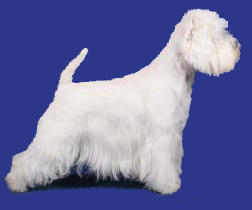
GENERAL APPEARANCE: Strongly built, deep in chest and back ribs; level back and powerful quarters on muscular legs and exhibiting in a marked degree a great combination of strength and activity.

CHARACTERISTICS: Small, active, game, hardy, possessed of no small amount of self-esteem with a varminty appearance.

TEMPERAMENT: Alert, gay, courageous, self reliant but friendly.

HEAD & SKULL: Skull slightly domed; when handled across forehead presents a smooth contour. Tapering very slightly from skull at level of ears to eyes. Distance from occiput to eyes slightly greater than length of foreface. Head thickly coated with hair, and carried at right angle or less, to axis of neck. Head not to be carried in extended position. Foreface gradually tapering from eye to muzzle. Distinct stop formed by heavy, bony ridges immediately above and slightly overhanging eye, and slight indentation between eyes. Foreface not dished nor falling away quickly below eyes, where it is well made up. Jaws strong and level. Nose black and fairly large, forming smooth contour with rest of muzzle. Nose not projecting forward.

EYES: Set wide apart, medium in size, not full, as dark as possible. Slightly sunk in head, sharp and intelligent, which, looking from under heavy eyebrows, impart a piercing look. Light coloured eyes highly undesirable.

EARS: Small, erect and carried firmly, terminating in sharp point, set neither too wide nor too close. Hair short and smooth (velvety), should not be cut. Free from any fringe at top. Round-pointed, broad, large or thick ears or too heavily coated with hair most undesirable.

MOUTH: As broad between the canine teeth as is consistent with the varminty expression required. Teeth large for size of dog, with regular scissor bite, i.e. Upper teeth closely overlapping the lower teeth and set square to the jaws.

NECK: Sufficiently long to allow proper set on of head required, muscular and gradually thickening towards base allowing neck to merge into nicely sloping shoulders.

FOREQUARTERS: Shoulders sloping backwards. Shoulder blades broad and lying close to the chest wall. Shoulder joint placed forward, elbows well in, allowing foreleg to move freely, parallel to axis of body. Forelegs short and muscular, straight and thickly covered with short, hard hair.

BODY: Compact. Back level, loins broad and strong. Chest deep and ribs well arched in upper half presenting a flattish side appearance. Back ribs of considerable depth and distance from last rib to quarters as short as compatible with free movement of body.

HINDQUARTERS: Strong, muscular and wide across top. Legs short, muscular and sinewy. Thighs very muscular and not to wide apart. Hocks bent and well set in under body so as to be fairly close to each other when standing or moving. Straight or weak hocks most under body so as to be fairly close to each other when standing or moving. Straight or weak hocks most undesirable.

FEET: Forefeet larger than hind, round, proportionate in size, strong, thickly padded. Under surface of pads and all nails preferably black.

TAIL: 13-15 cms (5-6 ins) long, covered with harsh hair, no feathering, as straight as possible, carried jauntily, not gay or carried over back. A long tail undesirable, and on no account should tails be docked.

GAIT/MOVEMENT: Free, straight and easy all round. In front legs freely extended forward from the shoulder. Hind movement free, strong and close. Stifle and hocks well flexed and hocks drawn under the body giving drive. Stiff, stilted movement behind and cow hocks highly undesirable.

COAT: Double coated. Outer coat consists of harsh hair, about 5 cms (2ins.) long free from any curl. Undercoat, which resembles fur, short, soft and close. Open coats most undesirable. Skin must appear healthy.

COLOUR: White

SIZE: Height: approx. 28 cms (11 ins) at withers

FAULTS: Any departure from the foregoing points should be considered a fault and the seriousness with which the fault should be regarded should be in exact proportion to its degree and its effect upon the health and welfare of the dog.

NOTE: Male animals should have two apparently normal testicles fully descended into the scrotum.

Need more info? Try these pages:
Questions and Answers
Westie Grooming

Back to the top



Home  |   About Westies  |   Members Area  |   Puppies  |   Westie Pics  |   Online Shop  |   About Us   |   Links

© 2010 West Highland White Terrier Club of Victoria Inc. All Rights Reserved.